Institute for Agricultural Research,
Ahmadu Bello University,
P.M.B 1044
Zaria.

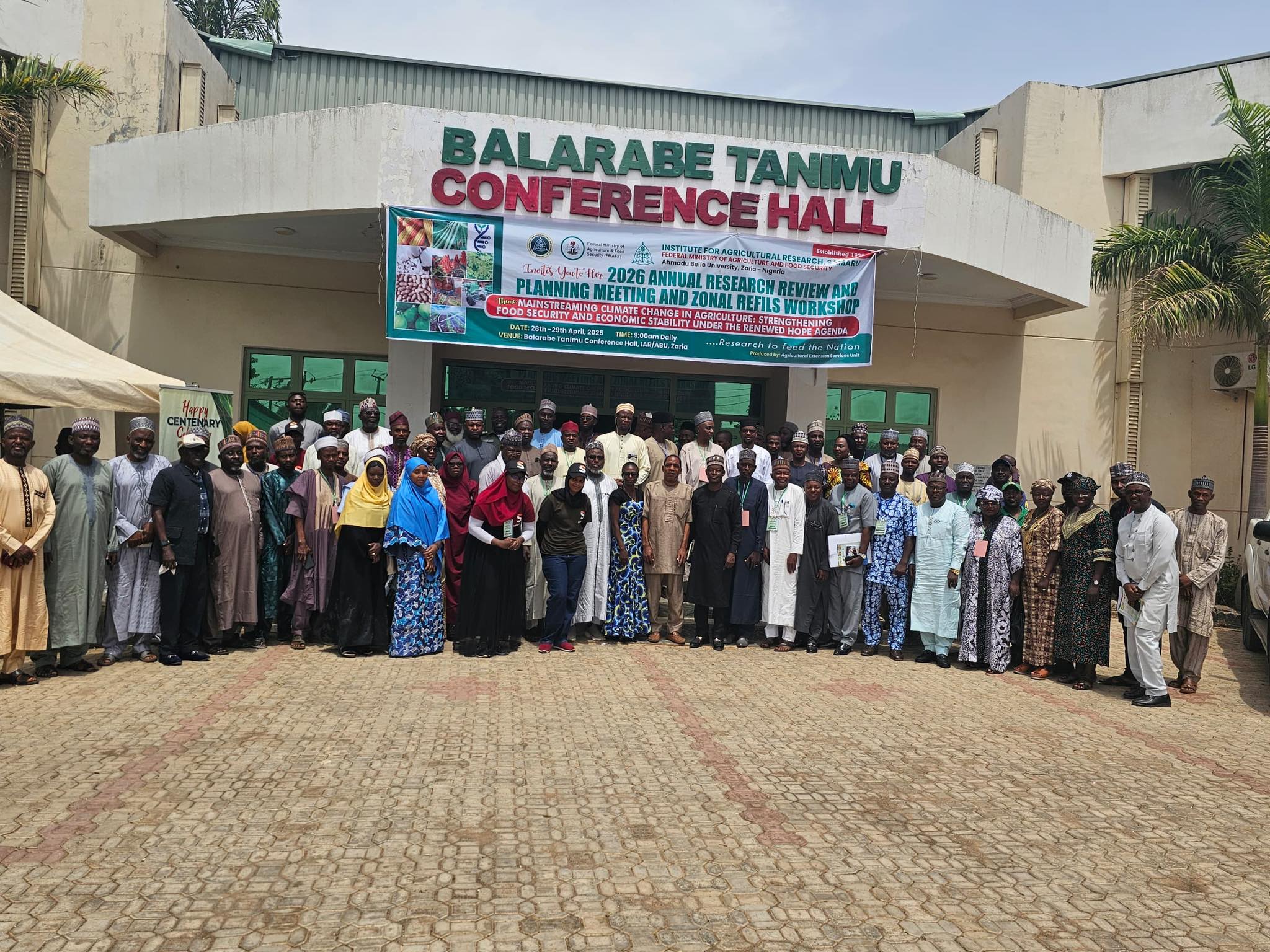
The second day (29th April 2026) of the 2026 Annual Research Review and Planning Meeting of the Institute for Agricultural Research (IAR), Ahmadu Bello University, Zaria, featured the Northwest Zonal Research Extension Farmer Input Linkage System (REFILS) Workshop, with a strong emphasis on stakeholder participation, practical solutions, and farmer-centered discussions.
The day commenced with a thought-provoking
presentation titled “Women at the Frontline: Transforming Nigerian Food Systems
through Extension and Innovation.” The presentation, originally by Ms. Mira
Mehta (CEO Tomato Jos Limited) and represented by Arewa Salome, highlighted the
work of Tomato Jos in promoting local tomato production for domestic
consumption while empowering women and strengthening Nigeria’s agricultural
value chain.
This was followed by presentations from
Agricultural Development Programmes (ADPs) across seven states Katsina, Sokoto,
Zamfara, Kano, Jigawa, Kaduna, and Kebbi. Representatives from these states
shared updates on their ongoing agricultural activities, proposed
interventions, and work plans for the current farming season. The session provided
valuable insights into regional agricultural priorities and reinforced the
importance of coordinated extension services in improving productivity and
farmer livelihoods.
A major highlight of the day was the Farmers
and Stakeholders Forum, which provided a unique platform for direct engagement
between farmers, researchers, and extension agents. Farmers openly discussed
the key challenges affecting agricultural productivity, including the rising
cost of fertilizers, herbicides, and farm machinery, as well as broader
economic realities influencing food production and market prices.
In response, farmers and other stakeholders
proposed several practical and forward-looking solutions, including:
Ø Adoption of local and organic fertilizer
alternatives to reduce dependence on expensive inputs.
Ø Strengthening farmer cooperatives with
effective management, enabling farmers to work collectively to improve
productivity and access resources.
Ø Development of crop varieties that require
lower fertilizer inputs, thereby reducing production costs.
Ø Improved support for processing, value
addition, and agribusiness development to increase farmer income.
Ø Reduction in the cost of farm inputs and
agricultural machinery.
Ø Encouraging farmers to adopt a
business-oriented approach to farming, treating agriculture as a profitable
enterprise.
Participants emphasized that despite the
prevailing challenges, farmers should remain encouraged and supported, as
agriculture remains the backbone of rural livelihoods and a cornerstone of
national food security.
The session was highly interactive and
solution-driven, fostering meaningful dialogue, knowledge exchange, and
collaboration among participants.
At the closing session, the communiqué of the
meeting was presented by Dr. Rekiya Abdulmalik, summarizing the key
discussions, outcomes, and resolutions from the two-day event.
The programme concluded with a vote of thanks
delivered by the Assistant Director, Extension Monitoring and Evaluation, Prof.
A. I. Sharifai, who expressed appreciation to all participants, partners, and
stakeholders for their active engagement and contributions toward advancing
agricultural development.
The 2026 IAR Annual Research Review and
Planning Meeting successfully ended with a renewed commitment among
stakeholders to strengthen collaboration, promote innovation, and enhance the
impact of research and extension services on farming communities across
Nigeria.
Together, we are building stronger linkages
between research, extension, and farmers for a more resilient and productive
agricultural sector.
#IARABUZaria #REFILS #AgriculturalResearch #FoodSecurity #ClimateSmartAgriculture #ABUZaria

Share This News