Institute for Agricultural Research,
Ahmadu Bello University,
P.M.B 1044
Zaria.

IAR Takes Nigerian Dryland
Agriculture to the Global Stage at Dryland Congress 2026
Dr. Muhammad Ahmad Yahaya wins Best Poster Award as Nigerian researchers strengthen South–South partnerships for resilient seed systems
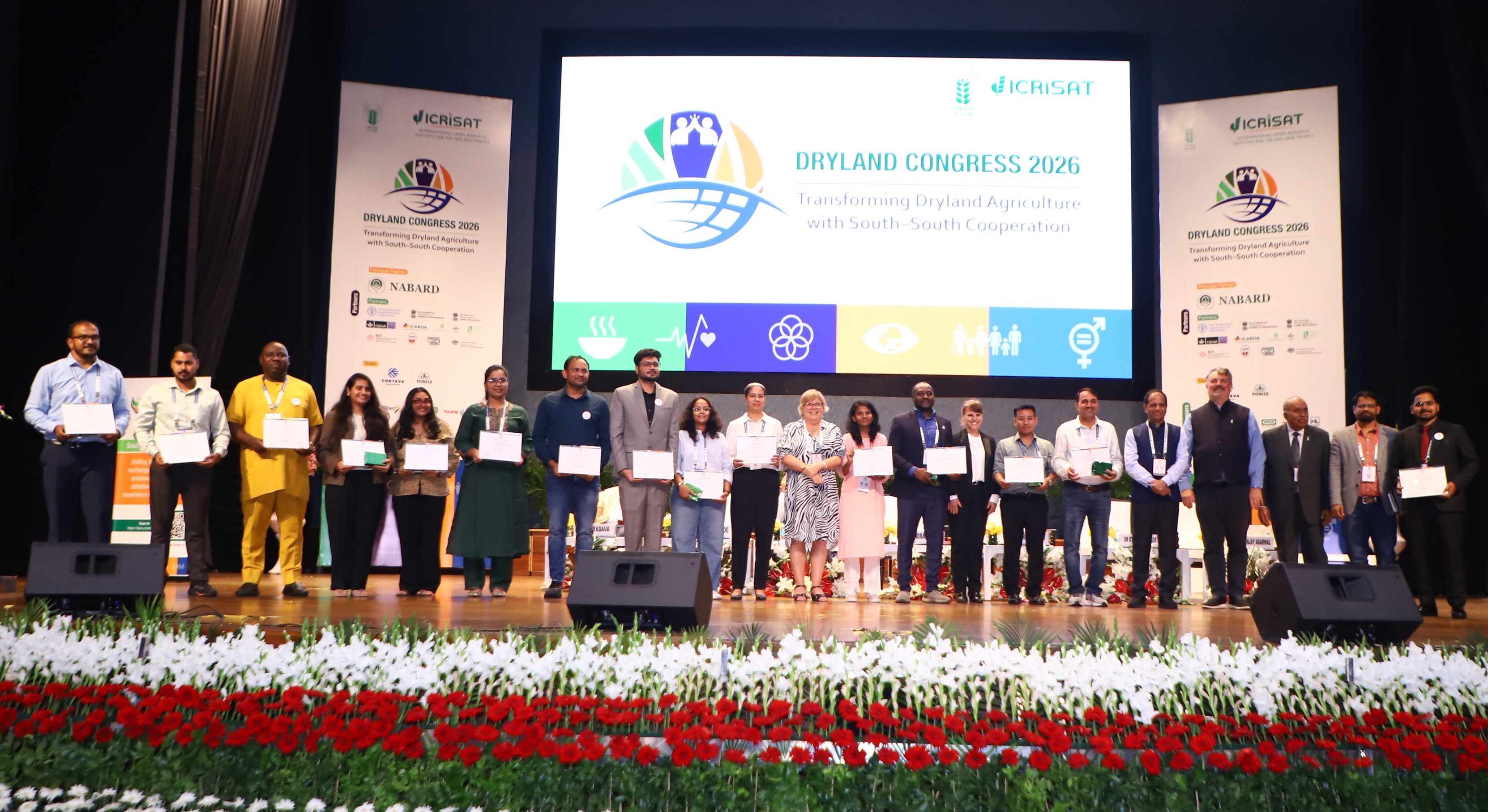
New Delhi, India | 12 September 2026 — The Institute for Agricultural Research (IAR), Ahmadu Bello University, Zaria, has strengthened Nigeria’s visibility in global dryland agriculture following a successful participation in the Dryland Congress 2026 – “Transforming Dryland Agriculture with South–South Cooperation,” held from 10–12 September 2026 at the National Agricultural Science Complex, New Delhi, India.
The Congress, jointly organised by the Indian Council of Agricultural Research (ICAR) and the International Crops Research Institute for the Semi-Arid Tropics (ICRISAT), brought together more than 800 scientists, policymakers, development partners, farmer representatives, industry leaders and researchers from more than 25 countries. Its focus was firmly on translating science, innovation and partnerships into practical solutions for the world's dryland communities.
For IAR, the Congress was particularly significant. It provided a platform to showcase Nigerian research, strengthen existing international relationships and explore new pathways for collaboration in crop improvement, seed systems, climate resilience, data, technology transfer and farmer-centred innovation.
IAR Scientist Wins Best Poster Award
A major highlight of the Nigerian participation was the recognition of Dr. Muhammad Ahmad Yahaya, Senior Scientist at IAR Samaru, who received the Certificate of Excellence – Best Poster Award at the Congress.
The award-winning research was titled: “Farmer and Community Managed Seed Systems: Bridging Formal and Informal Seed Systems for Scaling Improved Sorghum, Groundnut and Pearl Millet Varieties in Nigeria's Drylands.”
The certificate presented to Dr. Yahaya at the Congress recognises the work as a Best Poster Award and identifies the research as addressing the scaling of improved sorghum, groundnut and pearl millet varieties in Nigeria's drylands.
The research is a product of collaboration involving IAR, the Centre for Dryland Agriculture (CDA), Bayero University, Kano, the Lake Chad Research Institute (LCRI), CIMMYT and ICRISAT, a strong example of how national and international institutions can combine expertise around a practical challenge facing farmers.
The recognition is also highly relevant to the Congress agenda. “Transforming Seed Systems in the Global South” was one of its central themes, with emphasis on climate-responsive seed supply, strengthening African seed systems and improving the interface between formal and informal seed systems.
Why this matters for Nigerian farmers
The significance of the work goes beyond the award.
For farmers in Nigeria's drylands, having an improved variety is only the first step. The variety must also be available, affordable, accessible, adapted to local conditions and delivered at the right time.
This is precisely the challenge the Farmer and Community Managed Seed System (FCMSS) approach seeks to address. The model developed through the IAR-led work brings farmers, community seed producers, women’s groups, seed entrepreneurs, researchers and other actors into the seed delivery process.
CIMMYT has documented the Nigerian FCMSS experience as an approach that bridges traditional and formal seed systems, with local production helping improve access to quality sorghum seed for last-mile farmers.
This makes the Best Poster Award particularly meaningful: the research being recognised internationally is grounded in a very practical Nigerian question—how do we ensure that the improved genetics developed by breeders actually reach farmers?
“From Recommendations to Action, from Silos to Systems”
One of the strongest messages from the Congress was the need to move agricultural development beyond isolated interventions.
Dr. M. L. Jat, Secretary of the Department of Agricultural Research and Education (DARE) and Director General of ICAR, captured this clearly:
“From recommendations to action, from silos to systems — that is the pathway to transforming dryland agriculture.”
The message has direct relevance for Nigeria.
For Nigerian dryland agriculture, transforming the system means connecting breeding with seed production, seed production with markets, research with extension, farmers with processors, data with decision-making, and policy with implementation.
It also means recognising that the solutions required by farmers cannot come from research institutions alone.
The Congress demonstrated this systems approach by bringing together scientists, governments, development organisations, private-sector actors, farmer organisations and international research institutions.
A Strong Case for South–South Cooperation
Another important message emerging from New Delhi was that countries of the Global South do not have to solve similar problems independently.
Former ICRISAT Director General Dr. William D. Dar emphasised that South–South cooperation enables countries to learn, innovate and scale solutions together as equal partners, while Dr. Sandra Milach, Chief Scientist of CGIAR, highlighted the potential for innovations emerging from India to be adapted across other dryland regions.
This philosophy was particularly visible throughout the Nigerian delegation's engagements.
The IAR team had opportunities to interact with senior leaders and scientists including Dr. M. L. Jat, Secretary DARE and Director General ICAR; Dr. Himanshu Pathak, Director General ICRISAT; Dr. Stanford Blade, Deputy Director General for Research and Innovation at ICRISAT; Dr. Kevin Pixley, Director of the Dryland Crops Program at CIMMYT; and Prof. Rajeev Varshney of Murdoch University, Australia, among other international experts.
These interactions created space for discussions around future collaboration, scientific exchange, capacity development, crop improvement, seed systems and scaling of innovations for dryland farmers.
The Congress itself was designed around this philosophy: not merely exchanging knowledge but creating mechanisms through which proven solutions can be adapted and scaled across countries. ICRISAT's ISSCA platform, for example, is now working with partners across the Global South to accelerate the adaptation and scaling of agricultural innovations.
The Seed Question: From Improved Varieties to Improved Access
For Nigeria, perhaps one of the most important lessons from the Congress is that genetic improvement and seed-system development must move together.
ICRISAT has recently framed the issue bluntly: “Seeds are the foundation of agriculture and the starting point of food security.” The institution notes that the challenge in many parts of Africa is not simply the absence of improved varieties, but the difficulty of getting those varieties to farmers quickly, reliably and at scale.
That observation strongly
resonates with Nigeria's dryland agriculture.
Nigeria has considerable scientific capacity to develop improved sorghum, millet, groundnut, cowpea and other climate-resilient varieties. The next challenge is building efficient, inclusive and commercially sustainable delivery systems capable of putting those varieties into the hands of millions of farmers.
This is where the collaboration represented by the award-winning FCMSS research becomes particularly important.
It suggests a shift from asking only:
“What
variety can we develop?”
to also asking:
“What
system will ensure that farmers can access, produce, multiply, buy and
continuously replace quality seed of that variety?”
That is a question for breeders, seed companies, community seed producers, regulators, extension agencies, policymakers, development partners and farmers alike.
A Call for Data, Foresight and Living Laboratories
The Congress also carried an important message for agricultural policymakers.
At the closing session, Dr. Jat
called for robust data and information systems and for “living laboratories”
that connect research, practice and policy.
For Nigeria, this has important implications.
Dryland agriculture is changing rapidly under pressure from climate variability, population growth, market dynamics and resource constraints. Policy and investment decisions therefore need to be informed by reliable data on varieties, seed demand, production environments, farmers' preferences, climate risks, markets and value chains.
The future will require agricultural research institutions to work not only as places where varieties are developed, but also as knowledge and innovation platforms connecting data, farmers, policymakers, private enterprise and development partners.
Appreciation to ICRISAT and the Congress LOC
IAR expresses its sincere appreciation to Dr. Manzoor Dar, Global Head of Seed Systems and Principal Scientist at ICRISAT, for his gracious support in facilitating the participation of the Nigerian delegation at the Congress.
Dr. Dar's work centres on seed systems, agricultural innovation, partnerships and scaling—areas directly connected to the Nigerian research showcased at the Congress.
IAR also extends its appreciation to the Dryland Congress Local Organising Committee (LOC) and the entire ICRISAT and ICAR teams for the warm reception, excellent organisation and deliberate effort to create meaningful opportunities for interaction among researchers, policymakers, farmers and development partners.
Their support made it possible for
Nigerian researchers to contribute directly to one of the most important
international conversations on the future of dryland agriculture.
An Eye-Opening Experience—and a New Responsibility
For the IAR delegation, the Congress was more than a scientific gathering. It was an eye-opening experience of what the future of dryland agriculture could look like when science, policy, markets, farmers and international partnerships work together.
The three-day programme exposed participants to innovations spanning climate-resilient breeding, seed systems, water and land management, digital agriculture, nutrition, markets, resilient farming systems, and gender- and youth-centred approaches.
The Congress concluded with the Delhi Declaration on Drylands (3D), calling for stronger South–South and triangular cooperation, knowledge exchange, innovation and collective action. Dr. Himanshu Pathak, Director General of ICRISAT, challenged participants to move the outcomes of the Congress “from ideas to concepts and from concepts to concrete action and implementation.”
That message should resonate strongly in Nigeria.
For Nigerian farmers, the future of dryland agriculture must mean better varieties, reliable seed, stronger markets, improved water management, useful technologies and higher, more resilient incomes.
For Nigerian policymakers, it means building the institutions, policies, infrastructure, data systems and partnerships that allow those solutions to reach farmers at scale.
For Nigerian research institutions, it means moving increasingly from generating knowledge to generating impact—through partnerships that connect research to farmers, markets and policy.
The Best Poster Award received by Dr. Muhammad Ahmad Yahaya is therefore more than an individual scientific achievement. It is a recognition of collaborative Nigerian research addressing a real challenge in the drylands, and a reminder of what can be achieved when IAR, CDA, LCRI, CIMMYT, ICRISAT and farming communities work towards a common goal.
From Samaru to New Delhi, the message is clear: Nigeria has knowledge, institutions and innovations that can contribute to the global dryland agenda. The next step is to strengthen the partnerships that can take those innovations from research plots and community seed systems to millions of farmers.
And, as the Congress made clear, the future of dryland agriculture will not be built by one institution or one country—it will be built through science, systems, partnerships and action.
Share This News